No. You should accept that insurance approvals are sometimes outside the hospital’s control. You should not accept that the resulting discharge delays are an unavoidable cost of running a hospital.
For a 345-bed super-specialty hospital in Kolkata, this is not merely an administrative inconvenience. It is an operational bottleneck that can affect revenue, bed availability, patient experience, nursing workload, and even the utilisation of critical-care capacity.
And given that you’ve already tried multiple interventions, I would change the question. Rather than asking, “How do we make insurers approve faster?”, ask:
“How do we run the hospital so that an insurer’s delay causes the least possible disruption?”
That is a very different problem — and one the hospital has substantially more control over.
1. First, challenge the assumption that nothing can be done
There is an important regulatory point here. Under the IRDAI Master Circular on Health Insurance Business dated 29 May 2024, insurers are required to grant final cashless discharge authorisation within three hours of receiving the hospital’s discharge authorisation request. If the delay beyond three hours results in additional charges, the circular provides that those charges are to be borne by the insurer from its shareholders’ funds.
That gives you a concrete basis for escalation. But the clock starts when the insurer receives the formal discharge authorisation request — not necessarily when the doctor advises discharge.
This distinction matters because you need to separate delays attributable to the hospital from those attributable to the insurer or TPA.
2. Stop treating every delay as the same problem
I would divide the discharge journey into four stages.
Stage A — Clinical discharge readiness
Doctor's discharge advice → final clinical documentation and bill readiness. Identify any delay in summaries, prescriptions, investigations or final billing.
Stage B — Submission completeness
Bill and discharge documents → formal submission to insurer/TPA. Establish whether the first submission is complete or whether repeated queries and resubmissions are creating avoidable delay.
Stage C — Insurer/TPA authorisation
Formal discharge request received → final approval issued. Track elapsed time, query frequency, pending cases and whether the three-hour regulatory timeline is exceeded.
Stage D — Physical departure
Approval → settlement, medication, transport and patient departure. Measure the residual time after approval. This is where a hospital can still have substantial operational control.
The reason for doing this is simple: if the hospital spends an hour preparing the bill and the TPA spends another three hours processing it, pressuring the TPA alone will not eliminate the entire delay.
3. If you have already tried everything, change the level of intervention
I would move beyond routine follow-ups and introduce three management-level interventions.
A. Make delays measurable and attributable. For every insured discharge, record the timestamps above, the insurer/TPA, the reason for each query, the time taken to resolve it, and the final departure time. Report the median and 90th-percentile delays, not just the average.
B. Escalate using evidence rather than individual complaints. Prepare a monthly insurer/TPA scorecard showing turnaround times, cases exceeding three hours after formal discharge authorisation requests, repeat queries and the resulting additional bed occupancy. Escalate persistent breaches through the insurer's designated grievance mechanism and, where appropriate, the IRDAI grievance channels.
C. Treat the residual delay as a capacity-management problem. Ensure that discharge documentation and billing are prepared as early as clinically appropriate. Have a defined escalation owner for pending approvals, and coordinate pharmacy, billing, nursing and patient transport so that the patient can leave promptly once the required authorisation and discharge formalities are complete. Do not compromise clinical clearance or applicable contractual and financial safeguards.
4. The business case: quantify the cost of doing nothing
At approximately 65 discharges a day, even a modest reduction in avoidable discharge time can be operationally meaningful.
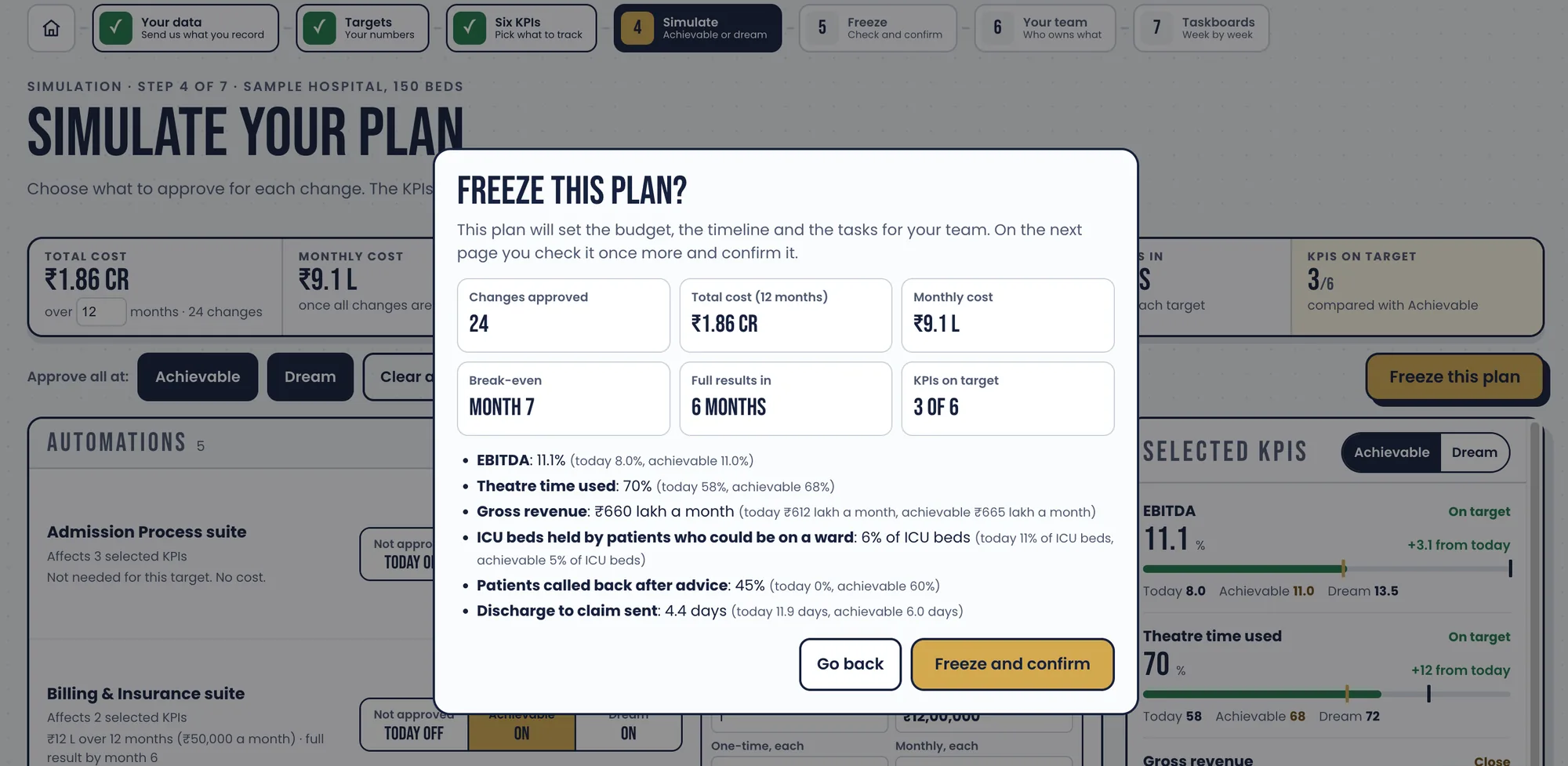
For illustration, if 30 insured patients per day experience a delay that can be reduced by two hours, that recovers 60 bed-hours daily — equivalent to 2.5 bed-days of capacity per day.
That is not automatically 2.5 additional occupied beds or incremental revenue. The financial benefit depends on demand, bed type, admission timing and whether the released capacity enables another admission.
The calculation should therefore distinguish:
- Capacity recovered: hours and bed-days released.
- Revenue opportunity: additional admissions that the recovered capacity actually enables.
- Direct savings: avoidable overtime, extended stay costs and other incremental expenses.
- Patient experience: waiting time after clinical discharge readiness.
The objective is not to claim that every delayed discharge costs the hospital an entire day's revenue. It is to determine what the delays are genuinely costing and where intervention produces a measurable return.
One question before I recommend the next move
You mentioned that you have already tried everything. I don't want to give you another list of routine measures you've already implemented.
Where is the principal bottleneck today?
- The TPA/insurer takes too long to issue final approval, even when documents are complete.
- Repeated queries, document requests or deductions keep restarting the process.
- The hospital also takes too long to complete billing and submit the discharge request.
- It varies by insurer, patient and department; we cannot isolate one cause.
Which patients are most affected?
- Cashless insurance patients only
- Both cashless and reimbursement-related discharges
The answer determines whether the next step should be regulatory escalation, redesigning the insurer interface, or a more fundamental change in how discharge operations are managed.
- Plan regulatory escalation for insurer delays beyond three-hour limit
- Design process improvements addressing repeated queries and resubmissions
- Optimize hospital discharge operations for billing and submission delays